
Mercor Breach: A Practitioner’s View on Deepfake Defense | Breacher.ai 2026
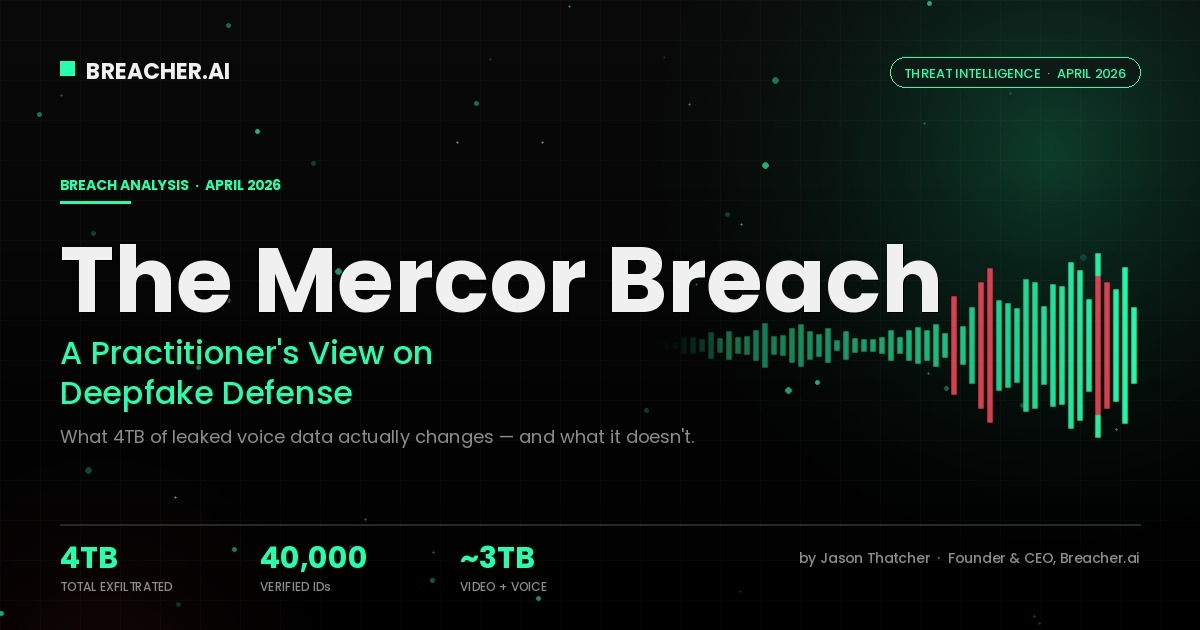
The Mercor Breach Didn't Create a New Threat.
It Industrialized an Old One.
A practitioner's view of what 4TB of voice data and 40,000 verified IDs actually changes for enterprise deepfake defense — and what it doesn't.
The Question CISOs Always Ask
We've been running orchestrated social engineering simulations against enterprise customers for over two years. Voice clones, deepfake video, multi-stage attack chains across email, Teams, and Zoom. Every time we publish results, the same question comes back from CISOs: "Where do attackers actually get the source audio?"
That question just got a 4-terabyte answer.
On April 4, 2026, the extortion group Lapsus$ posted Mercor — a $10B AI training data startup serving OpenAI, Anthropic, and Meta — to its leak site. The dump includes roughly 3TB of contractor voice recordings paired with government-issued ID scans for over 40,000 people, plus 939GB of source code and a 211GB user database with SSNs and full PII.
The headlines focused on Lapsus$ and the voice biometrics. The headlines missed the more important story.
The Supply Chain Attack Matters More Than the Leak
The actual breach vector wasn't a clever phishing campaign or a misconfigured S3 bucket. It was a software supply chain attack on LiteLLM, an open-source AI gateway downloaded roughly 95 million times per month.
A separate threat group, TeamPCP, compromised LiteLLM's CI/CD pipeline on March 24 and pushed malicious versions 1.82.7 and 1.82.8 to PyPI within 13 minutes of gaining access. The malware harvested API keys, cloud credentials, SSH keys, database passwords, and Kubernetes configs from every company that ingested those versions before they were pulled.
Mercor was one of those companies. Lapsus$ then leveraged TeamPCP's stolen credentials to exfiltrate the data and run the extortion play.
The voice data is the visible payload. The supply chain weakness is the durable problem.
This matters because TeamPCP has publicly stated intent to partner with multiple ransomware and extortion groups. Lapsus$ won't be the last leak from the LiteLLM compromise. Anyone gluing AI APIs together with the standard open-source toolchain — which is essentially every AI-adjacent company in the market — is exposed to the same threat model.
What Changes for Attackers, What Doesn't for Defenders
Until April 4, voice cloning attacks against named targets followed a predictable workflow: pick the target, scrape audio from public sources, train a model, pair with a pretext. That workflow had a natural ceiling. It scaled poorly. Mass campaigns weren't economical.
The Mercor breach inverts that math. A buyer of the leaked dataset now has 40,000 cleanly recorded voice samples paired with verified IDs. Off-the-shelf voice cloning tools require roughly fifteen seconds of clean reference audio. The Mercor recordings exceed that threshold by a factor of eight to twenty.
Mass deepfake campaigns become economical. A single attacker can now run automated voice cloning against thousands of identities in parallel. The same way credential stuffing made password reuse a mass-market problem, voice stuffing is about to make voice biometrics a mass-market problem.
KYC bypass becomes operational. A clean voice sample plus a verified ID for the same person clears both factors at financial institutions still using voiceprint matching as one of two factors.
Any employee is a target. Attackers don't need your executive's voice anymore. HR vishing, payroll redirect, vendor impersonation work just as well with a contractor's voice. Sometimes better, because contractors don't trigger the same scrutiny.
Voice alone should never authorize a financial action. This was true before Mercor. It is true now. Any wire transfer, vendor payment redirect, or credential reset that can be triggered by a phone call alone is an unmitigated control gap.
Out-of-band verification still works. A callback to a known number, a Slack message to the actual person, a physical walk to the requester's desk — none of these are defeated by voice cloning. They are defeated by employees who don't follow the policy.
Process controls beat detection products. Deepfake detection tools are an arms race that defenders are losing in slow motion. Authentication should never depend on the recipient's ability to detect a synthetic.
The Awareness Training Problem the Breach Amplifies
There's an uncomfortable truth in our engagement data that the Mercor news amplifies. Across organizations we've tested, most have at least one department vulnerable to a coordinated deepfake social engineering attack. Most users in our simulations cannot distinguish synthetic audio or video from real, even when primed to look for it.
These numbers come from organizations that have run extensive traditional security awareness training. Phishing simulations, awareness platform modules, annual compliance videos. The training works for the threat it's designed to address — generic email phishing. It does not transfer to the threat a CFO faces when an attacker calls finance pretending to be them with a voice that sounds exactly right.
The reason is straightforward: people learn from experience, and most employees have never experienced a realistic deepfake attempt. You cannot pattern-match against something you have never encountered. The Mercor breach guarantees more first encounters will happen in production rather than in training.
The Honest Enterprise Playbook
If I were sitting in a CISO seat reading the Mercor news, here's the order I'd work through this week. Not detection products. Not new vendor evaluations. The unglamorous work of mapping actual verification flows and testing them honestly.
Map Your Voice-Triggered Verification Flows
Not just executive impersonation. Helpdesk password resets, payroll change requests, wire approvals, vendor onboarding, MFA bypass calls. Any process where a human voice on the phone is sufficient to authorize an action. This is where the attacks will land, regardless of which celebrity-CEO scenarios get media coverage.
- Helpdesk password reset flows
- Payroll change request channels
- Wire transfer approval chains
- Vendor onboarding verification
- MFA bypass procedures
- Executive callback protocols
Audit Executive Voice Exposure
Treat executive audio as a discrete asset class. Public earnings calls, podcast appearances, conference recordings, LinkedIn videos — anything that gives an attacker reference audio without needing a Mercor-style breach. The exposure is rarely zero, but it is often quantifiable and partially controllable.
- Earnings call recordings
- Podcast appearances
- Conference video archives
- LinkedIn video posts
- Internal town hall recordings
- Media interviews
Confirm Your Supply Chain Isn't Downstream of LiteLLM
This isn't about voice. It's about the broader TeamPCP campaign. Anyone running AI integration code should audit dependency chains for the affected versions and rotate any credentials those dependencies could have touched. The leaked Mercor data is one outcome of the LiteLLM compromise. There will be others.
- LiteLLM 1.82.7 / 1.82.8 audit
- API key rotation
- Cloud credential rotation
- SSH key audit
- Kubernetes config review
- Database password rotation
Run a Realistic Simulation Before Relying on Training
I have a vested interest in saying this, so weigh accordingly. But the data is meaningfully different. Organizations that run coordinated multi-channel simulations against their own staff produce different outcomes from organizations that only run email phishing. People who have experienced one realistic deepfake attempt in a safe context recognize the second one. People who have only watched videos of deepfakes do not.
- AI voice helpdesk testing
- Deepfake video on Teams / Zoom
- Multi-stage kill chain replays
- Department-level susceptibility mapping
- Same-day employee debriefs
- Board-ready reporting
Don't Quote Inflated Stats in Your Board Deck
Some of the post-Mercor coverage cites numbers that don't survive a primary-source check. The breach is bad enough on its own facts. Cite the verified ones — Fortune's reporting on the LiteLLM supply chain attack, TechCrunch's confirmation of the data sample, the actual case filing in Gill v. Mercor.io Corporation in the Northern District of California — and skip the breathless figures.
- Fortune coverage of the breach
- TechCrunch sample confirmation
- Gill v. Mercor case filing
- Mercor official statement
- Snyk's LiteLLM analysis
- Trend Micro TrendAI report
Two Views · The Board and the Operator
The Mercor breach is being read two different ways inside enterprise security organizations right now. Both readings are correct. Both lead to action, but the actions are different.
A Legal & Reputational Asset Class Just Got Exposed
Five federal lawsuits filed within ten days. BIPA precedent makes class action exposure substantial for any organization collecting voice biometrics under training-data framing. Cyber insurance carriers are reading the same news your CISO is reading. The board's question is no longer whether to fund AI social engineering readiness — it is how the organization demonstrates the readiness when underwriters ask.
- Class action exposure for biometric data collection without explicit consent
- Cyber insurance underwriting questions about deepfake readiness
- Regulatory pressure under emerging AI governance frameworks
- Board fiduciary duty to address known, named, and active threat categories
- Public communications risk if a deepfake-enabled incident occurs
- Vendor and supply chain due diligence for AI-adjacent partnerships
A Threat Model Just Became Operational at Scale
The barrier to mass voice-cloning campaigns just collapsed. Helpdesk impersonation tooling that was previously the province of named-target attacks now scales to any contractor in the dataset. The operator's question is which existing controls actually hold under realistic conditions, and which were always assumed rather than tested.
- Voice-only verification flows mapped and treated as control gaps
- Helpdesk testing against AI voice agents on inbound and callback paths
- Executive impersonation scenarios across Teams, Meet, and Zoom
- Dependency audit for LiteLLM and adjacent supply chain exposure
- Out-of-band verification mandates for financial and access actions
- Realistic multi-channel simulation prior to relying on awareness training
The board needs evidence the threat is being addressed. The operator needs to know which controls actually work. The platform was designed so neither has to compromise.
The Longer Arc
The Mercor breach is not the inflection point. The inflection point was the moment voice cloning crossed the threshold of "needs a research lab" to "available off-the-shelf for $10 a month." That happened roughly two years ago.
What April 4, 2026 represents is the predictable consequence of that earlier inflection: voice biometrics, casually collected under "training data" framing, getting weaponized at scale through normal supply chain mechanics.
The next breaches will look similar. AI training data brokers, biometric authentication vendors, identity verification services — any organization sitting on a database that pairs voice or face with verified identity is a target. The defensive question is not whether your organization is in the next dataset. It's whether your verification processes still hold up when someone in the next dataset is one of your employees, your vendors, or your customers.
The deepfakes are only going to get better. The processes that defeat them have been the same since before any of this technology existed.
That is a process design question, not a detection product question. And it's answerable today, with controls that have existed for decades, if security teams are willing to do the unglamorous work of mapping their actual verification flows and testing them honestly.
Frequently Asked Questions
Direct answers to the questions security leaders, CISOs, and risk owners ask most often about the Mercor breach and its implications for enterprise deepfake defense.
The Lapsus$ extortion group posted approximately 4TB of data exfiltrated from Mercor, an AI training data startup serving OpenAI, Anthropic, and Meta. The dump includes roughly 939GB of platform source code, a 211GB user database, and approximately 3TB of video interview recordings and ID verification documents covering more than 40,000 contractors. The combination that matters for security teams is the pairing of studio-quality voice recordings averaging two to five minutes per contractor with verified driver's license or passport scans for the same individuals.
Both. The actual initial access vector was a software supply chain attack on LiteLLM, an open-source AI gateway, executed by a separate threat group called TeamPCP. TeamPCP compromised LiteLLM's CI/CD pipeline on March 24, 2026 and pushed malicious package versions to PyPI within 13 minutes. The malware harvested credentials from every company that ingested those versions. Lapsus$ then leveraged TeamPCP's stolen credentials to exfiltrate Mercor's data and run the extortion play. TeamPCP has publicly stated intent to partner with multiple ransomware groups, which means Lapsus$ will not be the last leak from the LiteLLM compromise.
Most prior voice leaks fell into one of two categories. Either call center recordings were stolen with no easy way to map audio back to identity, or ID-document brokers leaked driver's licenses and selfies without any audio attached. The Mercor onboarding pipeline merged both columns into a single database row: passport or driver's license scan, webcam selfie, and a sit-down voice recording reading scripted prompts in a quiet room. That sequence is exactly what a synthetic voice cloning service needs as input. Off-the-shelf voice cloning tools require roughly 15 seconds of clean reference audio. The Mercor recordings exceed that threshold by a factor of eight to twenty.
Five priorities. First, map every verification flow that can be triggered by voice alone — helpdesk password resets, payroll change requests, wire approvals, vendor onboarding, MFA bypass calls — and treat any flow without out-of-band verification as an unmitigated control gap. Second, audit executive voice exposure as a discrete asset class, including earnings calls, podcast appearances, and conference recordings. Third, confirm software supply chains are not downstream of LiteLLM and rotate any credentials those dependencies could have touched. Fourth, run a realistic multi-channel deepfake simulation against your own staff before relying on awareness training. Fifth, cite verified primary sources rather than inflated post-breach statistics in board materials.
No. Deepfake detection tools are an arms race that defenders are losing in slow motion. Every detector trained on today's voice and video models will be partially blind to tomorrow's. The honest defensive answer is that authentication should never depend on the recipient's ability to detect a synthetic. Process controls — out-of-band verification, mandatory callbacks to known numbers, dual approval for financial actions — defeat voice cloning regardless of how convincing the synthetic is. Detection products are useful as one input among many, but they cannot be the primary control.
Traditional phishing relies on text-based deception — emails, SMS, fake login pages. Defenders have spent two decades training employees to recognize textual red flags and verify links. Deepfake social engineering attacks the audio and video channels where defenders have invested almost no training and where employees have no pattern recognition. Organizations that have run extensive phishing awareness programs typically still fail at high rates against coordinated deepfake scenarios because the training does not transfer across modalities. The Mercor breach guarantees more first encounters with realistic deepfake attempts will happen in production rather than in training.
Yes. Any organization running AI integration code should audit dependency chains for the affected LiteLLM versions (1.82.7 and 1.82.8) and rotate credentials those dependencies could have touched, including API keys, cloud credentials, SSH keys, database passwords, and Kubernetes configurations. The broader lesson is structural: the AI infrastructure stack is built on standard, fragile, open-source foundations, and the same supply chain mechanics that enabled the Mercor breach will enable similar incidents. Continuous dependency monitoring and credential rotation hygiene are no longer optional for any organization gluing AI APIs together.
Five federal lawsuits were filed against Mercor in California and Texas courts between April 1 and April 7, 2026, all seeking unspecified monetary damages for violations of data privacy and consumer protection laws. The lead case is Gill v. Mercor.io Corporation in the U.S. District Court for the Northern District of California, filed as a proposed nationwide class action. Plaintiffs allege Mercor failed to implement multi-factor authentication, encrypt sensitive data during storage and transmission, limit access to PII, monitor systems for suspicious activity, or rotate passwords regularly. The Illinois Biometric Information Privacy Act precedent makes class action exposure significant for any organization collecting voice biometrics under training data framing.
Sources: Fortune coverage of the Mercor breach, TechCrunch reporting on the LiteLLM supply chain attack and Lapsus$ leak, Snyk security analysis of the LiteLLM compromise, Trend Micro TrendAI Research commentary, Strikegraph supply chain analysis, and the public case filing in Gill v. Mercor.io Corporation, Northern District of California. Engagement data is drawn from Breacher.ai client testing across Fortune 500 enterprises and federal engagements through Q1 2026.
Test What Actually Holds Under Pressure
Book a 30-minute scoping call. We will walk through your verification flows, identify the highest-risk voice-triggered paths, and design a realistic multi-channel deepfake simulation calibrated to your organization.
Latest Posts


Table Of Contents
About the Author: Jason Thatcher


 support@breacher.ai


