Agentic AI – Real Time Voice Phishing

Predictive TTS & Agentic AI: A Giant Leap Across the Uncanny Valley
New predictive modeling techniques in text-to-speech synthesis are rapidly eliminating the perceptual artifacts that allowed humans to distinguish synthetic speech from real. For social engineering attackers, the window is closing fast.
Experience a live example of AI-driven social engineering simulation. This interactive demo showcases the type of attack vector our red team deploys against enterprise targets. Launch Interactive Demo →
The Last Natural Barrier Is Eroding
For the past several years, synthetic speech has carried telltale signatures — micro-hesitations that land wrong, prosody that feels rehearsed, breath patterns that don't align with conversational rhythm. Trained ears, and even untrained ones, could sense something was off. That perceptual gap — the uncanny valley of synthetic voice — was one of the last natural barriers between threat actors and truly convincing voice-based social engineering.
That barrier is eroding fast.
A new generation of predictive modeling architectures for text-to-speech is fundamentally changing the threat surface. These aren't incremental improvements. They represent a structural shift in how synthetic speech is generated, moving from reactive frame-by-frame synthesis to anticipatory, context-aware speech production that mirrors the way the human brain actually plans and executes spoken language.
What Changed: Predictive Modeling in TTS
Traditional neural TTS systems operate sequentially — they process text input and generate corresponding audio frames in a largely linear pipeline. The result is speech that is technically accurate but perceptually flat. It lacks the subtle anticipatory cues that make human speech feel alive: the micro-inflection before a key word, the breath intake that signals a clause shift, the rhythmic acceleration through familiar phrases.
Predictive TTS models invert this approach. Rather than generating speech token-by-token, these architectures build a forward-looking representation of the entire utterance — or in real-time conversational contexts, the next several phrases — before generating audio. The model is effectively planning its speech the way a human speaker does: knowing where emphasis will fall, where pauses will land, and how intonation will arc across a complete thought.
- Anticipatory Prosody Planning Models now generate prosodic contours for full utterances before synthesizing audio. This eliminates the "local optimization" problem where each phrase sounds fine in isolation but the overall rhythm feels mechanical.
- Contextual Breath Modeling Breath events are no longer inserted at rule-based intervals. Predictive models learn respiratory patterns tied to emotional state, clause complexity, and conversational tempo — producing breath patterns indistinguishable from organic speech.
- Dynamic Micro-Pause Insertion Sub-200ms hesitations, filler sounds, and self-corrections are generated contextually based on the semantic difficulty of what's being said. This replicates the cognitive load signatures that human listeners unconsciously rely on to assess speaker authenticity.
- Real-Time Conversational State Tracking In agentic AI systems, predictive TTS integrates with dialogue state to adjust vocal characteristics mid-conversation — increasing urgency, modulating confidence, or introducing hesitation based on the evolving context of the exchange.
The combined effect is speech that doesn't just sound more human — it behaves more human. And that distinction matters enormously for security.
The Agentic AI Multiplier
Predictive TTS alone would be concerning. Combined with real-time conversational agentic AI, it becomes a force multiplier that fundamentally alters the economics of voice-based social engineering.
Modern agentic AI systems can sustain unscripted, goal-directed conversations in real time. They handle interruptions, respond to unexpected questions, adapt their strategy based on the target's responses, and maintain consistent persona characteristics across extended interactions. When you pair this conversational intelligence with predictive TTS that produces nearly indistinguishable-from-human speech, you get something that barely existed twelve months ago: a near-autonomous social engineering agent that can conduct convincing voice calls at scale.
The convergence of predictive TTS and agentic conversational AI is rapidly undermining the two primary constraints on voice-based social engineering campaigns: the need for a skilled human operator on every call, and the perceptual artifacts that gave targets a chance to detect deception. Threat actors no longer need to choose between quality and scale. They can have both.
This is not theoretical. Our threat research team has been tracking the development of these capabilities across both open-source and commercial ecosystems. The tooling to build real-time voice agents with predictive speech modeling is available now. The latency thresholds needed for natural conversational flow — sub-500ms round-trip — are being met consistently. The voice cloning fidelity required to impersonate a specific individual is achievable with as little as fifteen seconds of reference audio.
What This Means for Enterprise Security
The implications for organizations are immediate and concrete. Every process that relies on voice as an identity signal — helpdesk verification, executive authorization, vendor callbacks, out-of-band confirmation — is now operating on increasingly unreliable assumptions.
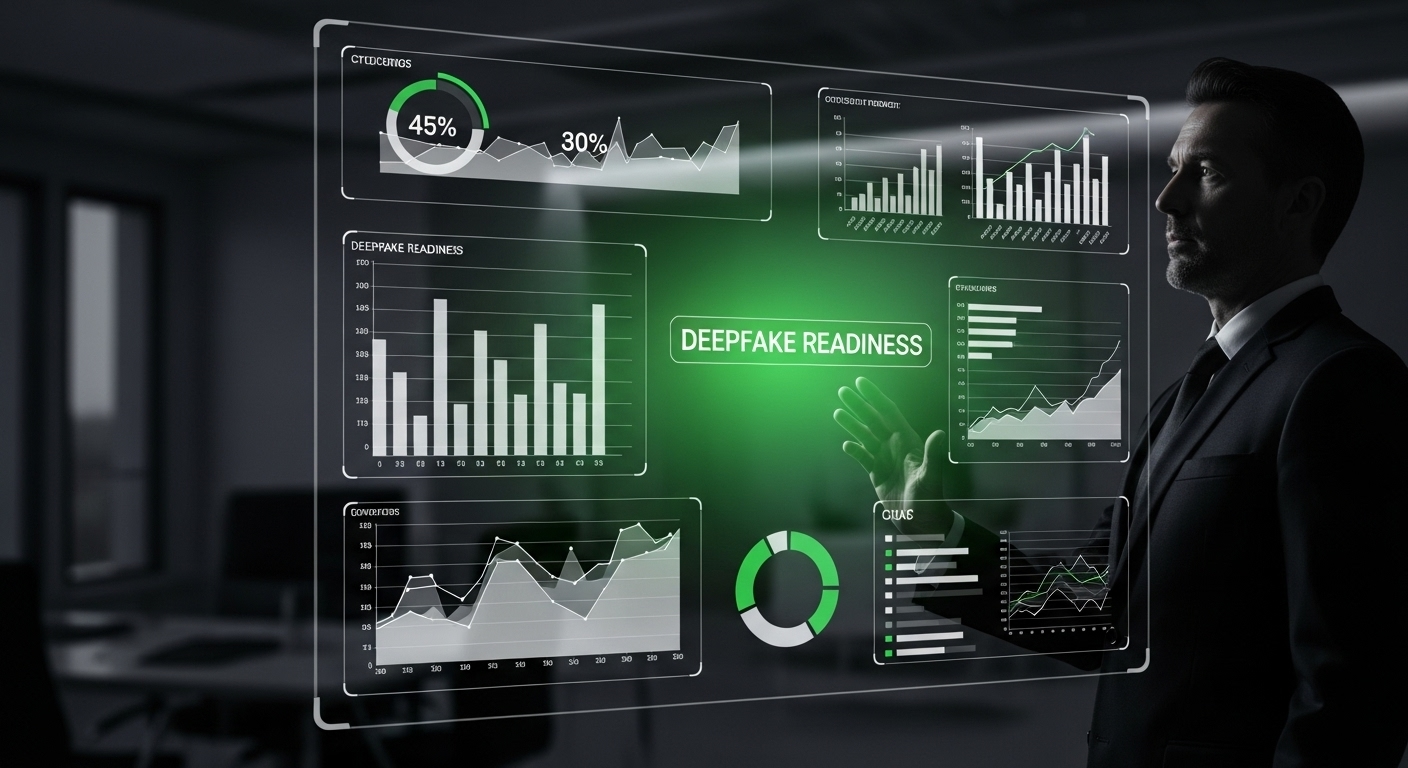
Those numbers came from our red team assessments before predictive TTS entered the picture. With these new capabilities deployed, we expect that 63% figure to climb significantly. As synthetic speech sheds more detectable artifacts, the question shifts from "can your people detect a deepfake?" to "how long before your processes can't assume they will?"
The Process Problem
Most enterprise security controls for voice-based interactions were designed in an era where producing a convincing voice fake required significant expertise, time, and a cooperative target. The new threat model seriously undermines those assumptions. A predictive TTS agent can cold-call your helpdesk, closely replicate the voice of an authorized executive, navigate your verification questions in real time, all without a human threat actor ever picking up a phone.
The attack chain is no longer constrained by human labor. It's constrained by API rate limits.
How We're Responding
At Breacher.ai, our job is to ensure our clients understand these threats before they encounter them in production. Our deepfake red team assessments now incorporate the latest predictive TTS and agentic AI capabilities to deliver testing that reflects the actual threat landscape — not last year's threat landscape.
This means live voice engagements using real-time conversational AI against your employees, your helpdesk, your verification workflows. We don't send a questionnaire. We send a phone call that your team won't know is synthetic — because it's built on the same technology that adversaries are deploying right now.
Organizations cannot defend against threats they haven't experienced. Awareness training tells employees that deepfakes exist. Red team assessments show them what a deepfake attack actually feels like — and reveal the process-level failures that training alone will never fix.
We've been tracking and operationalizing these capabilities since before any security vendors acknowledged they existed. That head start matters. Understanding the nuance of how predictive prosody planning affects detection rates, how agentic conversation management defeats scripted verification flows, and how voice cloning fidelity varies across different synthesis architectures — this is the kind of deep technical knowledge that separates a genuine threat assessment from a checkbox exercise.
What Comes Next
The trajectory is clear and accelerating. Within the next twelve months, we expect real-time voice agents with predictive TTS to be available as turnkey SaaS offerings — lowering the barrier to entry for threat actors from "capable developer" to "anyone with a credit card." Multilingual capabilities are expanding rapidly. Emotional modeling is getting more sophisticated. The gap between synthetic and organic speech will continue to narrow until reliable human detection becomes the exception rather than the rule.
The organizations that will weather this shift are the ones that stop treating voice verification as a reliable security control and start treating it as an attackable surface. That requires testing. Real testing. Against the actual capabilities that threat actors have access to today.
Layer 7 is the new perimeter. And the voice on the other end of the line can no longer be trusted by default.
Test Your Organization Against Real AI Threats
Find out how your team and processes hold up against the latest deepfake social engineering capabilities — before an adversary does.
Latest Posts


Table Of Contents
About the Author: Jason Thatcher


 support@breacher.ai