
Best AI Phishing Simulation Platforms for 2027
Best AI Phishing Simulation Platforms for 2027, Ranked on What the AI Actually Does
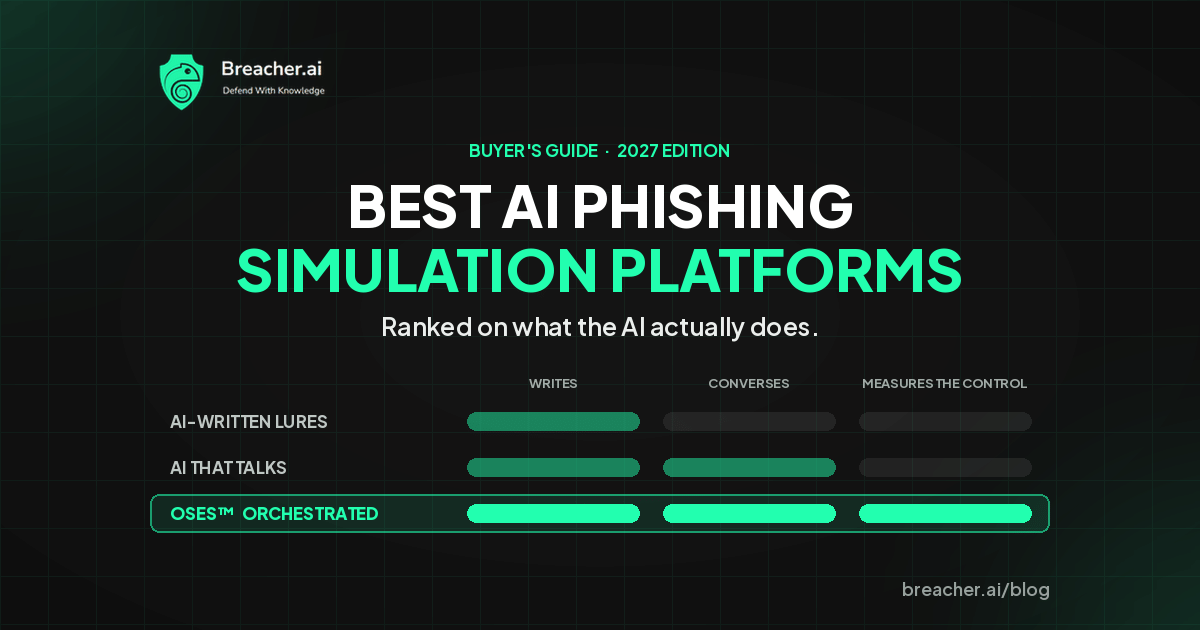
Every phishing simulation vendor now says AI. We scored six platforms on three jobs the AI can do: write the lure, hold the conversation, and measure whether your verification procedures held. Only one does all three.
An AI that writes a better email is a feature. An AI that holds the call, answers the callback and tells you which control broke is a platform.

What are the best AI phishing simulation platforms for 2027?
AI phishing simulation platforms reviewed from public documentation
Criteria scored, from AI-written lures to the inbound callback
Jobs the AI can do: write, converse, and measure the control
Two years ago, "AI phishing simulation" meant a language model that wrote a more convincing email. That bar is now table stakes. Every platform on this list generates lures, personalizes them, and builds training from the results. The real separation in 2027 sits further down the kill chain: whether the AI can hold a live conversation, whether it follows the target across channels, and whether the report tells you which procedure failed.
This guide ranks the platforms on that separation. If you want the narrower view, we also compare phishing simulation platforms on orchestration alone and score the best deepfake phishing simulation platforms on synthetic media.
AI phishing simulation platforms compared on 13 criteria
| Criterion | Breacher.ai | Adaptive | Doppel | Hoxhunt | Jericho | revel8 |
|---|---|---|---|---|---|---|
| Orchestrate and measure | ||||||
| Orchestration: next step branches on whether the target verified | Yes | No claim | No claim | No claim | No claim | No claim |
| Scores procedural failure, not only clicks | Yes | Partial | Partial | Partial | Partial | No claim |
| Peer vertical benchmark | Yes | No claim | Partial | No claim | No claim | No claim |
| Converse live | ||||||
| Live two-way AI voice agent | Yes | Yes | Yes | Partial | Partial | Partial |
| AI answers the inbound callback | Yes | No claim | No claim | Partial | No claim | No claim |
| Live AI avatar inside Teams or Zoom | Yes | No claim | Partial | Partial | Partial | Partial |
| Content and deployment | ||||||
| AI-generated lures and templates | Yes | Yes | Yes | Yes | Yes | Yes |
| Generates phishing simulations from threat intel | Yes | Yes | Yes | Yes | Partial | Partial |
| AI builds phishing landing pages from a screenshot | Yes | No claim | No claim | No claim | No claim | No claim |
| OSINT-driven personalization | Yes | Yes | Yes | Partial | Yes | Yes |
| Training generated from results or your policies | Yes | Yes | Yes | Yes | Yes | Yes |
| Two-way Microsoft Attack Simulator sync | Yes | No claim | No claim | No claim | No claim | No claim |
| Published pricing | Yes | No claim | No claim | No claim | Partial | No claim |
Competitor cells reflect vendor websites and third-party coverage reviewed in November 2026. A full circle means documented, a half circle means limited, unclear or third-party only, and an empty circle means we found no public documentation. Breacher.ai cells are first-party. Vendors can send corrections through our contact page.
What makes a phishing simulation platform AI-powered in 2027?
Ask any vendor where the AI sits and you will hear one of three answers. They are not equal, and each one builds on the last.
AI that writes
Generated lures, templates and training. The model drafts the email, the SMS or the landing page, personalizes it from open source intelligence, and turns a failure into a short lesson. Every platform below does this well. It makes the first message more convincing. It does not change what happens after the first message.
AI that converses
A live, two-way agent on the phone or in the meeting. The adversaries driving vishing and help desk fraud do not send a recording. They talk, they handle objections, and they call back. A simulation that cannot answer the inbound callback misses the moment where the most consequential requests are made, because the target is the one who dialed.
AI that orchestrates and measures the control
The next step depends on what the target did, and the score names the procedure that broke. An email, then a two-week wait, then a call that references the email. A target who verifies through a known-good channel ends the sequence; a target who skips the check moves to the consequential request. That is orchestrated social engineering simulation, and it is the only job that tells you whether your controls hold.
Multi-channel is not orchestration. Sending email, SMS and voice is a channel list. Orchestration is what the second step does differently because of the first.
The 6 best AI phishing simulation platforms for 2027
Ranked by how many of the three jobs each platform documents publicly, with the strongest fit for each named so you can match a platform to your program.
Breacher.ai: best for orchestrated AI simulation that measures your people, processes, and controls
The only platform in this review that documents all three jobs. The OSES™ engine runs a two-way AI voice agent that places the call, leaves the voicemail and answers the inbound callback, and a live AI avatar that joins Microsoft Teams and Zoom as a participant and holds a conversation. Each step branches on what the target did. Results roll up into the OSES™ Risk Index, which weights process failure above clicks and ranks you against your peer vertical. OSES™ Behave then generates training from your own policies and your own findings, in any language. Breacher.ai also syncs two ways with Microsoft Attack Simulator, is SOC 2 attested, and works with some of the largest organizations in the world.
Adaptive Security: best for an all-in-one suite that scores the individual
Broad coverage in one contract. Adaptive pairs AI phishing simulation across email, SMS, voice and video with a large training library, OSINT-driven personalization, real-time voice and per-employee risk scoring, alongside adjacent email security and AI governance products. It is a strong pick for teams that want one vendor for awareness. Look closely at whether the simulation answers an inbound callback and whether results score the procedure or the person.
Doppel: best if you require brand protection
Threat intelligence that feeds simulation. Doppel turns impersonation it finds through its brand protection product into simulations, runs conversational vishing, documents multistep campaigns and Teams and Zoom simulations, and publicly describes testing callback and out-of-band verification. Its metrics center on per-user report rate and time to report, and its threat research describes what attackers are doing rather than how organizations hold up.
Hoxhunt: best for adaptive, per-employee training at scale
Gamified, personalized and high volume. Hoxhunt adapts difficulty to each employee, has extended its training to Teams, SMS, callback phishing and deepfake video, and added AI voice agents that let employees practice a conversation. Third-party reviews describe that conversation as taking place inside the Hoxhunt experience, and its deepfake meeting scenario as a look-alike meeting page, so check whether you need a live call to a real phone or a real meeting.
Jericho Security: best for small teams that want self-service setup
Agentic simulation you can start on your own. Jericho describes an agentic AI platform for conversational phishing across email, voice and SMS, offers self-service subscription tiers, and generates micro-training from results. Public pages do not describe inbound callback handling, a named conferencing platform, or a peer benchmark.
revel8: best for European buyers who want an EU-built platform
AI-native and built in Germany. revel8 runs OSINT-personalized simulations across email, SMS, voice, video and Teams, with a gamified training academy and ISO 27001 certification, which suits European data residency requirements. Public material focuses on awareness and training outcomes rather than measuring procedural verification or publishing benchmark data.
Why a more realistic AI fake is not the finish line
Better generation makes every simulation more convincing, and that is the trap. If the platform measures whether employees spotted the fake, its results decay every time the models improve. Human perception of synthetic voice and video is a decaying control, which is why we argue that deepfake detection training is a decaying control.
A procedure does not decay the same way. A bank teller who checks the security strip catches a crude counterfeit and a perfect one alike. A callback to a known-good number returns the same answer whether the voice on the line is cloned badly or flawlessly. Invariance is not total: a better fake raises the pressure to skip the step, which is why the measure that matters is the exception rate. People still matter enormously, because people are the ones who execute the procedure. Technical identity verification matters too, including liveness checks, document validation and synthetic media screening on the channel, and a good simulation tests whether those controls hold as well.
Click rate, report rate and a per-employee risk score. Useful signals, but incomplete: they stop before the outcome and say little about whether a password reset, a wire or a vendor bank change would have gone through.
Verification coverage across consequential actions, process hold rate under live pressure, and exception rate, each with its denominator, plus where your organization ranks against its peer vertical.
How to choose an AI phishing simulation platform: three questions
Take these into every demo. Each one separates the platforms that write from the platforms that test.
- Does the AI hold a live conversation, including the callback? Ask to hear the agent answer an inbound call from a target who dialed the voicemail number, and to see the avatar join a real Teams or Zoom meeting.
- Does the next step depend on what the target did? Ask what happens when a target verifies through a known-good channel versus when they comply. If both paths look the same, the campaign is a funnel, not a sequence.
- Does the report name the control that broke and rank you against peers? Ask for a sample report that shows process failure by consequential action and your position in your vertical, not only a click rate.
For a deeper checklist, see our guide on how to choose social engineering simulation software, and for the voice channel alone, the best vishing simulation platforms.
Which AI phishing simulation platform fits your program?
| If your priority is | Best fit |
|---|---|
| Proving your verification procedures hold against live AI voice, video and callbacks | Breacher.ai |
| Extending Microsoft Attack Simulator with AI voice and meeting simulations | Breacher.ai |
| Ranking your organization against its peer vertical for the board | Breacher.ai |
| One vendor for awareness content, email security and AI governance | Adaptive Security |
| Brand and executive impersonation monitoring alongside simulation | Doppel |
| Gamified, per-employee adaptive training across a large workforce | Hoxhunt |
| Self-service setup for a smaller team | Jericho Security |
| An EU-built platform for European data requirements | revel8 |
Breacher.ai runs alongside any awareness platform. Many teams keep their training vendor and add orchestrated simulation on top.
How Breacher.ai runs AI phishing simulation
Breacher.ai is built around three modules that work separately or as one loop on the OSES™ simulation platform.
OSES™ Simulate
Orchestrated simulations across email, voice, Teams and Zoom. The AI Concierge turns a news story, an acceptable use policy or a screenshot into a simulation in minutes. The AI vishing simulation places the call, leaves the voicemail and answers the callback, and a live avatar joins the meeting. No tenant allow-listing is needed for Teams.
OSES™ Score
A risk score that measures the control, not the person. Findings are named against procedures, weighted toward process failure, and ranked against your peer vertical so you can tell an outlier from a sector median.
OSES™ Behave
Training built from your policies and your findings. Secure Behavior Management generates branded modules in any language, keyed to the procedure that failed, so people rehearse the verification step instead of hunting for glitches.
It fits the stack you already run: Entra ID and Google user sync, SSO, API, CLI and webhooks, plus a Microsoft Attack Simulator add-on that writes results back into Microsoft. Pricing is public. The standalone AI Vishing Simulator starts at $199 a month, and a fully managed IT impersonation and AI vishing assessment is $4,800 for up to 250 users. See Breacher.ai pricing for every plan.
Measure your risk.
Train for what you find.
Prove it changed.
Watch the AI place the call, answer the callback and join the meeting, then see the score it produces.
Book Your DemoFrequently asked questions
The best AI phishing simulation platforms for 2027 are Breacher.ai, Adaptive Security, Doppel, Hoxhunt, Jericho Security and revel8. Breacher.ai ranks first because its AI holds live voice and video conversations, answers the inbound callback, branches on what each target does, and scores whether your verification procedures held.
An AI phishing simulation is an authorized test that uses AI to generate, personalize and deliver social engineering scenarios to employees. Basic platforms use AI to write the email. Advanced platforms use AI voice agents and video avatars that hold live conversations, and orchestrate multi-step sequences that branch on how each person responds.
Some can. Breacher.ai uses a two-way AI voice agent that calls the target, leaves a voicemail if nobody answers, and holds a live conversation when the target calls back. Other platforms offer voice clone calls or practice conversations inside their own training app, so ask every vendor whether the agent answers inbound callbacks.
Click rate is useful but incomplete. It stops before the outcome. Voice, meeting and callback scenarios often have no link to click, and the consequential step is a password reset, a wire or a bank detail change. Track verification coverage, process hold rate and exception rate alongside it.
Not as the primary control. Human perception of synthetic voice and video decays as generation improves. Train employees to invoke a verification procedure, such as a callback to a known-good number, and back it with technical identity verification. General security awareness training still earns its place.
Most AI phishing simulation vendors quote privately. Breacher.ai publishes its pricing: the AI Vishing Simulator starts at $199 a month, and a fully managed IT impersonation and AI vishing assessment is $4,800 for up to 250 users.
Put every AI phishing simulation platform to the same test
Bring your verification procedures. We will show you an AI that calls, calls back and joins the meeting, and a score that tells you which control held.
Book Your DemoLatest Posts

Table Of Contents
About the Author: Jason Thatcher


 support@breacher.ai


