CISO Guide 2027: Policy, Procedure and Process
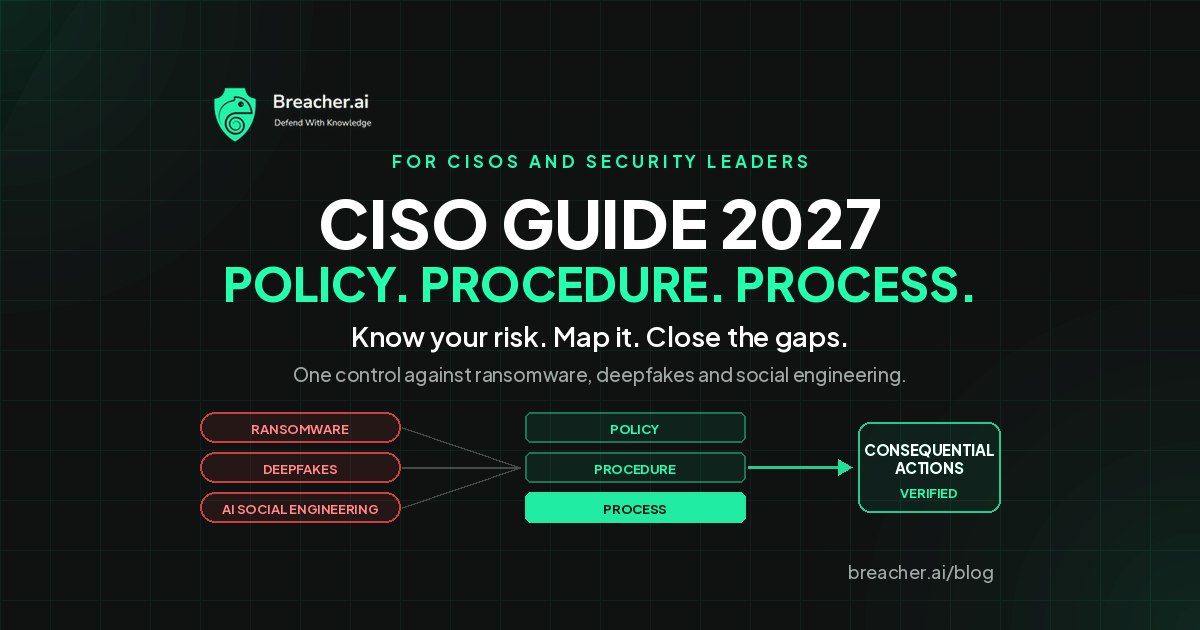
CISO Guide 2027: Policy, Procedure and Process. One Control Layer Against Ransomware, Deepfakes and AI Social Engineering.
The data from 2026, the three biggest deepfake heists of the year, your OSES™ Risk Score, a grid to map your exposure, and a People, Process and Technology plan to close the gaps, including awareness training generated from your own procedures.
Teaching users to spot deepfakes is a battle already lost. Teaching them the process is a battle you can win, measure and report to your board.

What is the CISO Guide 2027?
The CISO Guide 2027 is a plan for the year AI social engineering went mainstream. It shows that ransomware, deepfakes and AI voice phishing all end at the same consequential actions, and that policy, procedure and process, tested under pressure and measured with a risk score, is the one control layer that holds against all three.
Two questions decide your 2027 program. First, understand your risk, and how you rank against your peers. Second, close the gaps the score reveals with controls that do not decay. This guide answers both, and every section maps to a page of the downloadable handout so you can take it straight into a board meeting.
What changed in 2026: AI voice phishing works at scale
of users contacted fell for AI voice phishing
average action rate, of users contacted, across our most recent simulations
Autonomous voice agents now place the call, leave the voicemail and answer the callback without a human operator. The same IT support pretext that barely worked a year earlier now moves an average of 11.5 percent of users contacted to the consequential step. We published the detail in our AI vishing field findings. Three findings from that work should shape your 2027 plan.
The callback is the danger zone
Most outbound calls go to voicemail, and the inbound callback is where the most severe outcomes happen. The user called the number, so there is no urgency and no suspicion. A voice test that does not capture the callback misses the most important result.
IT support is a false green flag
A password reset call from support is routine, so red-flag training never fires. Support is often outsourced, so an unfamiliar voice is normal. People read identifiers aloud on a call that they would never type into a form.
Process beats perception
A workforce that invokes process defeats our red teams. Users who try to spot the fake do not, at least not consistently. One sentence ends the simulation: "I need to verify this request with our internal team."
The top 3 deepfake heists of 2026
The public record tells the same story at a larger scale. Each of the year's three biggest deepfake cases ended at a consequential action that a channel-independent verification step would have stopped.
FaceStealer, North Korea
Recorded webcam footage and deepfakes of trusted contacts on fake Zoom and Teams calls talked victims into installing malware, over 18 months. Our FaceStealer breakdown covers the chain.
Process that stops it: verify any meeting invite out of band, and never install software because a caller asks.
The AI CEO and lawyer ring
An e-signature NDA lure, then a call with an AI clone of the CEO voice and at times face, then a fake lawyer instructing the wire. Alleged, July 2024 to February 2026. See our executive impersonation briefing.
Process that stops it: call the CEO back on the number on record, and require dual approval on any confidential deal.
Fideuram, Intesa Sanpaolo
A WhatsApp message posing as the group CEO, then a call with an AI clone of a lawyer the chairman knew. Eleven transfers abroad. Read the Fideuram analysis.
Process that stops it: verify through a channel the requester did not choose, no matter how familiar the voice.
FaceStealer is a campaign total and the $129M is an alleged total across many victims; the defendants are presumed innocent. Fideuram is a single incident, about $108M. Sources listed at the end of this guide.
One front door, three threats
CISOs budget ransomware, deepfakes and social engineering as three problems with three tools. Look at how the incidents start and they collapse into one: a consequential request reaching a person with the authority to say yes. The FBI and CISA describe Scattered Spider talking IT help desks into password and MFA resets before deploying ransomware. In the Clorox lawsuit against its former help desk provider, the complaint alleges a defined reset procedure existed and was not followed. No deepfake was needed. The control was never run.
The adversary does not need to beat your EDR. They need your help desk to say yes.
Protect the handful of consequential actions every path ends at, a credential reset, an MFA enrollment, a remote session, a wire, a vendor bank change, a privileged access grant, and you harden against all three threats at once. Our companion piece on help desk identity verification goes deep on the front door most adversaries use first.
Why teaching users to spot deepfakes is a battle already lost
Detection is a decaying control. Generation quality improves every quarter and human perception does not, so every hour spent teaching the tell buys a skill that loses value from the day it is delivered. We made the full case in deepfake detection training is a decaying control. Procedure is an invariant control. A callback to the number on record returns the same answer against a crude voice clone and a perfect one. No bank relies on a teller eyeballing a counterfeit note. It requires the teller to run the check. The note got better. The check did not have to.
Judge whether a voice, face or message is synthetic. Falls as fakes improve, and fails silently when the fake is good enough, which is exactly when it matters.
Run a verification step before any consequential action, whatever you believe. Holds against any fake, is observable, and is measured as a process hold rate.
To keep this precise: general security awareness training still earns its place, and so does teaching people to inspect things that can be inspected, such as sender domains and links. Machine identity verification, including phishing-resistant MFA, document checks, liveness detection and synthetic media detection on the hiring channel, is a real control, and Breacher.ai tests whether it holds. What we will not do is make an employee the deepfake detector.
Policy, procedure and process: the three layers that hold
Layer 03 is the only one an adversary meets. It is also the only one most programs never measure.
A policy is a statement of intent. It protects nothing until it becomes a procedure someone can execute, and that procedure becomes a process people actually run under pressure. Coverage is the limit: most organizations have a verification step for outbound wires and nothing for MFA re-enrollment, vendor banking-detail changes or a support request arriving over Teams. And invariance is not total. A better fake does not break the procedure; it raises the pressure to grant an exception, which is why the exception rate is the number to watch.
Resilience = Policy coverage × Process hold rate
Understand your risk, and how you rank against your peers
A click rate tells you who was curious. It does not tell you whether the wire went out. The OSES™ Score measures how far an orchestrated simulation got and how much of your workforce went with it, then places you on a four-band scale you can report to the board and compare against your sector.
OSES™ Score = Depth + Spread
The deepest point any single person reached. Not divided by headcount, because one person is enough to be breached. Depth floors at 70 the moment an outcome produces a real consequence, so a breached organization can never score low.
The share of the population that moved. Per capita and capped, so volume can never mask a contained breach, and a click counts for a fiftieth of a consequential action.
Each person is counted once, at the deepest rung they reached. The Depth floor of 70 lands any escalation in High or above.
Your score matters most in context. Placed against your sector, it tells you whether you are an outlier or whether the median itself is the problem. That comparison, not a click rate, is what a board can act on.
Map your risk: the consequential action grid
Map risk on the actions an adversary wants, not on the lures they send. Place each consequential action by how likely it is to be targeted and how much damage one success would cause. The top-right cells are where verification has to hold first.
Placement is the Breacher.ai default assessment for a typical enterprise, not field data. The handout includes a fill-in version to score your own coverage.
Close the gaps: People, Process and Technology
Every consequential action needs all three layers. Technology reduces how often a person has to decide. Process makes the decision channel-independent. People rehearse the step until invoking it is a reflex.
| Action | People | Process | Technology |
|---|---|---|---|
| Help desk password reset | Agents rehearse refusing resets that skip verification, even for executives | Callback to the number on record, never the number offered | Self-service reset with document and liveness checks as the default path |
| MFA re-enrollment or phone change | Agents treat every MFA change as a privileged action | Second-channel approval from the manager or account owner | Phishing-resistant MFA so lost-factor cases are rare |
| Remote support session | Employees know support never cold-calls for remote access | Verify any support contact through the service portal | Restrict external Teams contact and unapproved remote tools |
| Outbound payment or wire | Finance rehearses the callback under executive pressure | Dual approval plus callback for any new or urgent payment | Payment holds for new payees and changed amounts |
| Vendor banking-detail change | AP staff know the change request is the lure | Confirm with a known vendor contact from the master file | Bank account validation and a change-hold window |
| Fake candidate hire | Recruiters know the pretext can be the candidate | Identity gate before offer and again before provisioning | Document verification, liveness and synthetic media detection on the interview channel |
| Privileged access grant | Admins escalate, never fulfil, urgent access requests | High-assurance or in-person verification for Tier 0 accounts | Just-in-time access with approval workflow and logging |
| Identifier read-back | Everyone knows no one legitimate asks for an ID aloud | Never confirm identifiers on an inbound or unsolicited call | Identifiers alone never authenticate a request |
| Data export or disclosure | Data owners verify the requester, not the story | Written request through a known channel plus owner sign-off | DLP and approval gates on bulk export |
Hardening guidance aligns with FBI and CISA advisory AA23-320A and Mandiant UNC3944 guidance.
Close the gap with awareness training generated from your procedure and process
Generic awareness training cannot teach a callback rule it does not know exists. The Secure Behavior Management platform reads your own policies, procedures and simulation findings and generates the training that rehearses them, in minutes, in any language. Every module teaches one thing: invoke the process.
Your procedure
The help desk reset SOP, the payment approval policy, your acceptable use policy, a threat report, or your simulation findings.
Training in minutes
Your exact steps become micro-modules, scenarios and matching simulations. The AI Concierge turns a news story into both.
The paths that failed
Modules go to the roles your OSES™ Score says are weakest. No hyper-training everyone on everything.
Process hold rate
The next orchestrated simulation shows whether the step holds under pressure, reported to the board.
The Callback Rule: Verifying Every Reset Request
Audience: service desk agents · Assigned after an inbound reset simulation
"No password or MFA reset without a callback to the number in the HR directory. Never use a number the caller provides." Quoted from your SOP, not a generic template.
A caller who sounds exactly like your CFO is locked out minutes before a board call. The voice is perfect. The procedure does not change.
Agents practise the exact line, "I will call you back on the number we have on file," and practise holding it when the caller pushes back.
Short questions on when the callback applies, which number to use and what to do when it fails, reported back into the platform.
Illustrative module. Content is generated from each customer's own documents.
What to report to the board, and a 90-day plan
- Coverage rate. Consequential actions with a channel-independent verification step, over all consequential actions you identified.
- Process hold rate. Simulated requests where verification was executed, over simulated requests that required it. This replaces click rate as the headline.
- Exception rate. Simulated requests where verification was waived or bypassed, over simulated requests that required it. Watch it as fakes improve.
Map and cover
Plot every consequential action on the grid and mark which have a written, channel-independent verification step. That ratio is your coverage rate. Close the gaps with policy first.
Write and teach
Turn each policy into a procedure a person can follow in under a minute, then generate training from it. Retire identity questions an adversary can answer from LinkedIn, and add a shields-up switch for periods of heightened threat.
Test and rank
Run orchestrated simulations against the top-right of your grid. Report coverage, process hold and exception rates, findings against procedures rather than people, and your OSES™ Score against your sector.
How Breacher.ai helps CISOs counter all three threats in one platform
Breacher.ai tests the human layer and the procedural layer together. We are not the answer that replaces your controls. We are the answer that tells you whether they hold.
Orchestrated, the way real adversaries operate
OSES™ runs the full sequence, not a single lure. An email, a wait, then a call that references the email. AI voice agents that handle the outbound call, the voicemail and the inbound callback. A help desk impersonation simulation over Teams, a cloned executive voice, or a live avatar joining a meeting. Multi-channel is not orchestration.
Findings against procedures, ranked against peers
Every finding names the control that held or failed, not the person. Coverage, process hold and exception rates by action, plus your OSES™ Score and your position against your sector.
Built from your own policies
Training generated from your procedures and your results, in minutes, in any language. Import your own content, sync users with Entra ID or Google, and run alongside Microsoft Attack Simulation Training. SSO, API and SOC 2.
Write the policy.
Rehearse the procedure.
Test the process.
Get your OSES™ Score and a gap map for every consequential action before your board asks.
Book Your DemoDownload the CISO Guide 2027 handout
Five pages, built for the board meeting
The 2025 versus 2026 data, the top 3 deepfake heists of 2026, the OSES™ Risk Score, a fill-in risk grid with a coverage checklist, the People, Process and Technology plan, and training generated from your procedures.
Frequently asked questions
The CISO Guide 2027 is a plan for the year AI social engineering went mainstream. It shows that ransomware, deepfakes and AI voice phishing all end at the same consequential actions, and that policy, procedure and process, tested under pressure and measured with a risk score, is the one control layer that holds against all three.
Autonomous AI voice agents made voice phishing work at scale. In Breacher.ai simulations, 1 to 3 percent of users contacted fell for AI voice phishing in 2025, against an average action rate of 11.5 percent of users contacted in 2026. The inbound callback is where the most severe outcomes happen.
The North Korean FaceStealer campaign, tied by the Justice Department to more than $400 million in crypto theft through fake video calls; an alleged $129 million ring that cloned CEO and lawyer voices to order wires; and the roughly 95 million euro Fideuram case, which used a fake WhatsApp CEO message and a cloned lawyer voice.
Human detection of synthetic voice and video decays as generation quality improves, so it fails exactly when the fake is good enough to matter. A verification procedure, such as a callback to the number on record, works the same against any fake. Train people to invoke the process, and test that it holds.
The OSES™ Score is the Breacher.ai social engineering risk score. It adds Depth, the deepest step any single person reached, to Spread, the share of the workforce that moved, and places the result in one of four bands from Low to Critical so you can compare it against your sector.
Breacher.ai generates awareness training from your own policies, procedures and simulation findings in minutes, in any language. Each module rehearses the exact verification step a role must run, goes to the paths your OSES™ Score shows are weakest, and is measured by the process hold rate in the next simulation.
Sources
- Breacher.ai, AI vishing field findings: breacher.ai
- US Department of Justice, actions to disrupt North Korea theft of cryptocurrency (FaceStealer), November 2026: justice.gov
- Coverage of the SDNY indictment in the alleged $129 million AI impersonation case, November 2026: thenextweb.com
- Reuters reporting on Fideuram via Cybernews, September 2026: cybernews.com
- FBI and CISA, Scattered Spider advisory AA23-320A: cisa.gov
- Mandiant, UNC3944 hardening guidance, May 2025: cloud.google.com
- SecurityWeek, Clorox sues Cognizant over 2023 hack, July 2025: securityweek.com
Find Out Where You Rank Before Your Board Asks
Run an orchestrated simulation, get your OSES™ Score, and close the gaps with training built from your own procedures.
Book Your DemoLatest Posts
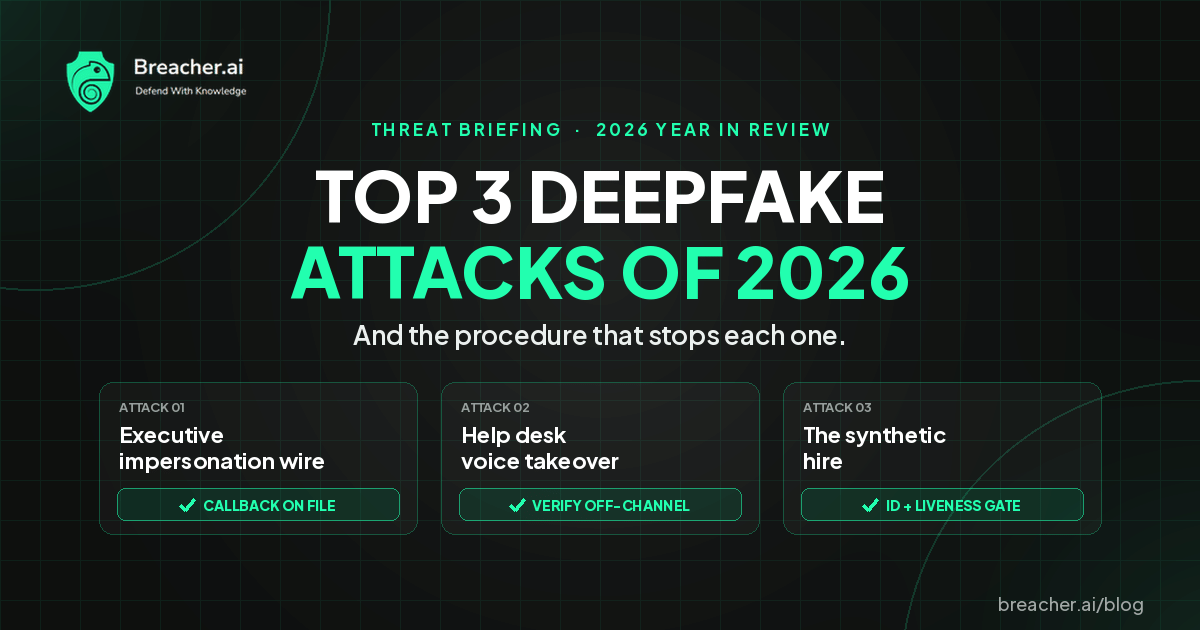
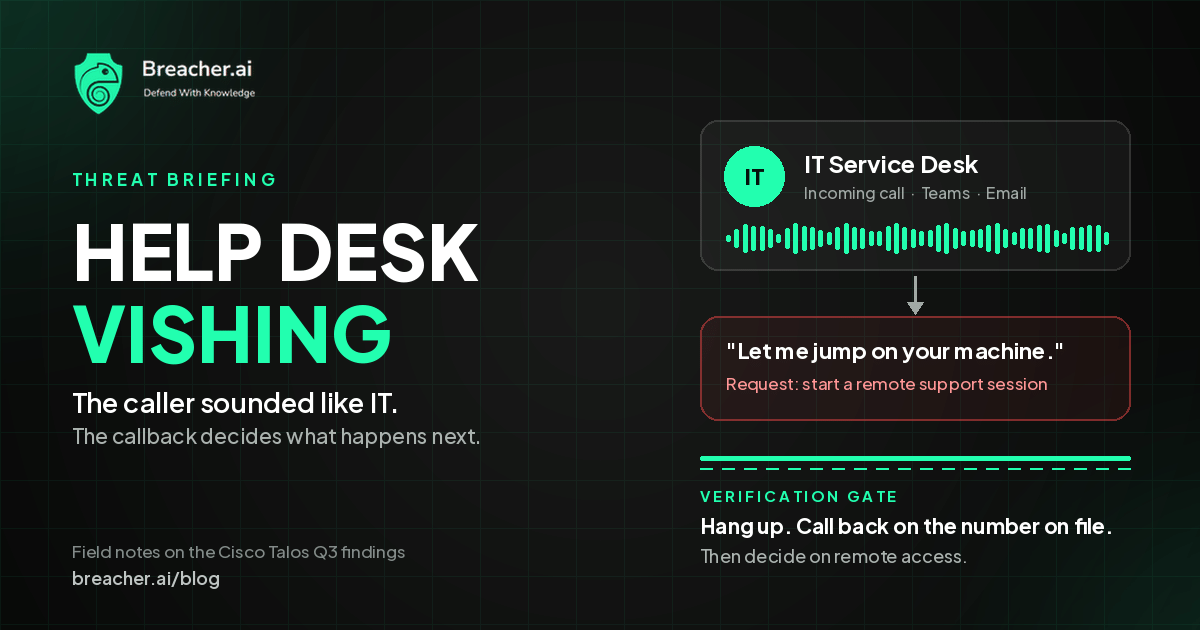
Table Of Contents
About the Author: Jason Thatcher


 support@breacher.ai