The Top 3 Deepfake Attacks of 2026, and the procedure that stops each one
The Top 3 Deepfake Attacks of 2026, and the procedure that stops each one
A cloned voice that moved EUR 95 million out of a private bank. A phone call that turned into a stolen single sign-on account in minutes. A face-swapped candidate who was handed a laptop and a codebase. Here is how the top deepfake attacks of 2026 worked, and the verification step that would have stopped every one.
Every top deepfake attack of 2026 ended at the same place: a consequential action with no independent verification step in front of it.

What were the top deepfake attacks of 2026?
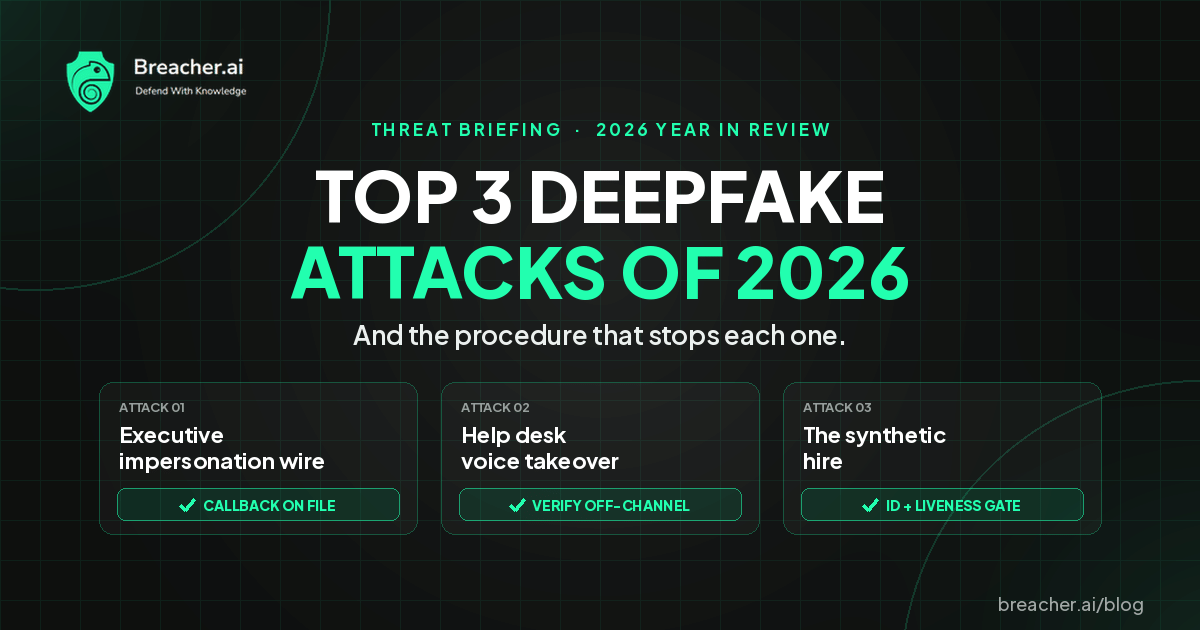
The top three deepfake attacks of 2026 were the executive impersonation wire, led by the roughly EUR 95 million Fideuram fraud; the help desk voice takeover, where callers talk staff into credential and MFA resets; and the synthetic hire, where face-swapped candidates pass remote interviews. Each one ends at a consequential action that a verification procedure can stop.
of 297 CISOs surveyed by Gartner reported a deepfake incident on an employee audio call in the past 12 months
of the same 297 CISOs reported a deepfake incident on an employee video call
vishing intrusions in the first half of 2026 against the second half of 2025, per CrowdStrike
2026 was the year deepfakes stopped being a novelty and became standard tradecraft. The headline losses grew, the voice channel became the busiest front door into the enterprise, and nation-state operators turned synthetic identity into a hiring pipeline. Three attack patterns did most of the damage, and they share one thing that matters far more than the quality of the fake.
I have run social engineering engagements for fifteen years, and at Breacher.ai we rebuild these patterns as authorized simulations. Below are the three that defined the year, what each one targeted, and the control that holds against a perfect fake as well as a crude one. If you want the full ledger of individual cases, our ranked list of the biggest deepfake attack examples on record covers ten of them.
The 3 deepfake attacks that defined 2026
The executive impersonation wire
The largest deepfake fraud on public record ran on WhatsApp and a cloned voice. In February 2026, the then chairman of Fideuram, the private banking arm of Intesa Sanpaolo, received messages that appeared to come from the group CEO about a confidential deal. A call followed from what sounded like a senior partner at a well-known law firm, confirming the instruction. The voice was synthetic. About EUR 95 million left the bank for accounts mainly in China, Hong Kong and Portugal. Fideuram spotted the irregularities quickly, and cooperation between authorities in Italy, China and Portugal recovered roughly EUR 53 million. About EUR 36 million is still missing.
The help desk voice takeover
The phone became the fastest route to a single sign-on account. CrowdStrike measured vishing intrusions in the first half of 2026 at twice the rate of the previous six months. The eCrime groups CORDIAL SPIDER and SNARKY SPIDER used voice calls to compromise SSO accounts, then pulled data out of SaaS applications. In one SNARKY SPIDER intrusion, the gap between account takeover and data theft was under five minutes. The caller does not need to be a perfect clone. They only need the help desk to reset a password or enroll a new MFA device on the strength of a voice.
The synthetic hire
Deepfakes moved from the payment desk to the hiring pipeline. In February 2026, GitLab threat intelligence described a North Korean cluster that scraped photos, used face-swap tools and forged passports to build at least 135 synthetic personas, and used them to reach at least 48 private codebases. Palo Alto Networks Unit 42 has documented operators running real-time face swaps in live video interviews. Once the offer letter goes out, the attacker is an employee with a laptop, credentials and legitimate access.
A callback to a number you already hold returns the same answer against a crude fake and a perfect one.
Three attacks, one pattern
Put the three side by side and the deepfake is never the end of the story. It is the piece that removes the last doubt in front of a consequential action: a payment, a credential reset, or an access grant. That is where each attack can be stopped, and it is where your controls should be tested.
| Attack | Channel | Consequential action | Control that holds |
|---|---|---|---|
| Executive impersonation wire | Messaging app, then a cloned voice call | Outbound payment | Callback on a known-good number, plus a second approver who verifies outside the story |
| Help desk voice takeover | Inbound or outbound phone call | Password reset, MFA enrollment | No reset on caller-asserted identity; verify through a channel the caller did not supply |
| Synthetic hire | Live video interview | Access provisioning | Document and liveness verification against authoritative sources, gated before any account is created |
Sources: Reuters and Corriere della Sera reporting on Fideuram; CrowdStrike 2026 Threat Hunting Report; GitLab Threat Intelligence, February 2026.
Three things repeat across all of them. Authority: the request comes from a CEO, an IT colleague or a hiring manager's ideal candidate. Urgency or secrecy: a confidential deal, a locked-out user, a role that needs filling now. Corroboration: a second voice or a second channel that seems to confirm the first, but sits inside the same script. The Fideuram case had a second confirmation; it simply came from the attacker.
Why spotting the fake is not the control
Asking employees to hear the glitch or catch the lip-sync drift is a control that gets weaker every time the models improve. We made that case in depth in why deepfake detection training is a decaying control. A verification procedure does not care how good the fake is. Either the callback to the number on file happened, or it did not.
Gartner reached the same conclusion this year. Its first recommendation to CISOs after the 2026 survey was to move training from spotting fakes to verifying consequential requests, and to test that behavior with simulations. That is the exact discipline we built the Breacher.ai platform around.
Two points of precision matter here. First, procedures are not magic. They hold at the level of the written rule, and pressure creates exceptions, which is why the number worth tracking is the exception rate. Fideuram shows how a confidentiality story can push people to skip escalation. Second, this is not an argument against technology. In the hiring path especially, machine identity verification, liveness checks and synthetic media detection on the interview channel are exactly the right gates. The question is whether they hold, and that is something you test rather than assume.
Click rates on email lures and scores on spot-the-deepfake quizzes. Neither tells you whether a payment, a reset or a new hire would have been stopped.
Verification that executes at the consequential action, every time, under pressure. Measured as coverage, process hold rate and exception rate.
How to get ahead of the next three in 2027
- Map your consequential actions. List every payment, banking-detail change, credential or MFA reset and access grant, then check which ones have a channel-independent verification requirement attached. That is your coverage.
- Attach a verification step the attacker cannot supply. Callbacks to numbers you already hold, second approvers who verify independently, and identity verification gates before provisioning. No deal is too secret to verify.
- Test the procedure under realistic pressure. Run the attack chain end to end as an authorized simulation, across email, voice, video and chat, and measure whether the procedure held, not whether someone noticed the fake.
How Breacher.ai tests all three before an attacker does
Breacher.ai runs orchestrated social engineering simulations, OSES™, that recreate each of these patterns safely and with full authorization. Multi-channel is not orchestration. OSES sequences each step with branch logic and a context layer, so an email lure can be followed days later by a call that references it, the way real campaigns unfold. Our CEO fraud simulation tests the executive wire path. Our vishing simulation runs a live, two-way AI voice agent that can handle the inbound callback as well as the outbound call. Our deepfake simulation brings synthetic voice and video into the scenarios that matter to your hiring and finance teams, including the checks described in our analysis of the fraudulent hire.
Findings are scored against your procedures, not your people, and benchmarked against peers in the OSES Risk Index. OSES Behave then generates awareness training aligned to your own policies, processes and controls, in minutes, from what the simulation actually found. One simulation platform covers red team, simulations, awareness training and tabletop exercises.
Measure your risk.
Train for what you find.
Prove it changed.
Find out which of 2026's top three deepfake attacks would work against your procedures today.
Book Your DemoFrequently asked questions
The top three deepfake attacks of 2026 were the executive impersonation wire, led by the roughly EUR 95 million Fideuram fraud; the help desk voice takeover, where callers talk staff into credential and MFA resets; and the synthetic hire, where face-swapped candidates pass remote interviews. Each one ends at a consequential action that a verification procedure can stop.
The Fideuram fraud in February 2026. Fraudsters impersonated the Intesa Sanpaolo CEO in messages and used a cloned voice of a senior lawyer to confirm a confidential deal, and about EUR 95 million left the bank. Roughly EUR 53 million was recovered through cooperation between authorities in Italy, China and Portugal, and about EUR 36 million remains missing.
Attach a channel-independent verification step to every consequential action: payments, credential and MFA resets, and access provisioning. Call back on a number you already hold, require a second approver who verifies independently, and put identity verification and liveness checks in front of hiring. Then test that those procedures hold under pressure with authorized simulations.
Sources
- Gartner, CISO survey on deepfake social engineering, September 22, 2026
- CrowdStrike, 2026 Threat Hunting Report, August 3, 2026
- Cybernews, citing Reuters, on the Fideuram fraud
- Il Sole 24 Ore, citing Corriere della Sera, on the Fideuram recovery
- GitLab Threat Intelligence, North Korean tradecraft, February 19, 2026
- Palo Alto Networks Unit 42, North Korean synthetic identity creation
Test all three before an attacker does
Run the executive wire, the help desk takeover and the synthetic hire as authorized simulations, and see exactly where your verification procedures hold.
Book Your DemoLatest Posts
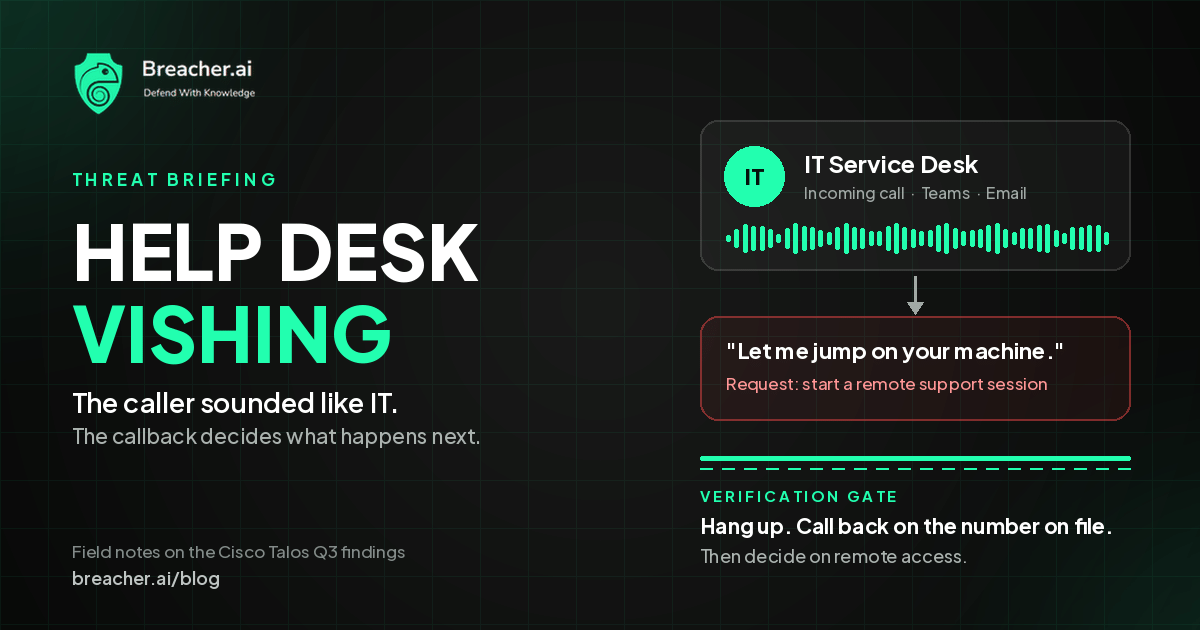
Table Of Contents
About the Author: Jason Thatcher


 support@breacher.ai