NIST 800-53 AT-2 practical exercises
NIST 800-53 AT-2 Practical Exercises, and How to Prove Yours Hold
NIST 800-53 AT-2(1) asks for more than a training course. It asks for practical exercises that simulate real events and incidents, and NIST names no-notice social engineering as the example. Here is what the control says, where it sits in the baselines, and how to produce evidence an assessor will accept.
A training course shows that people sat through the material. A practical exercise shows what they do when the request is real.

What is NIST 800-53 AT-2(1) Practical Exercises?
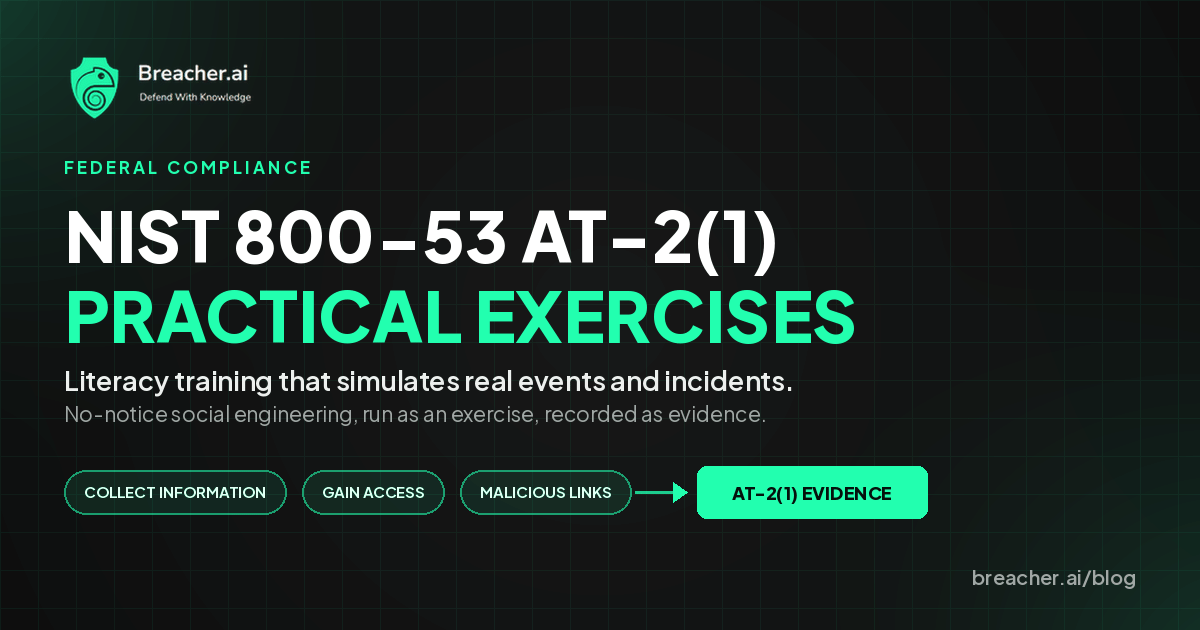
NIST 800-53 AT-2(1) is the Practical Exercises enhancement to Literacy Training and Awareness. It directs organizations to provide practical exercises in literacy training that simulate events and incidents. NIST lists no-notice social engineering attempts to collect information, gain unauthorized access, or simulate opening malicious attachments and links as examples.
exercise objectives named in the AT-2(1) discussion: collect information, gain access, simulate malicious content
SP 800-53B baselines (Moderate and High) that allocate AT-2(3) Social Engineering and Mining
SP 800-53B baselines that allocate AT-2(1) by default, so organizations tailor it in
AT-2 is the literacy training and awareness control in the Awareness and Training family of NIST SP 800-53 Revision 5. The base control covers the training itself. Its enhancements say what that training has to include, and the first one, AT-2(1), is the one that turns training into rehearsal.
The supporting discussion is unusually specific for a NIST control. Practical exercises include no-notice social engineering attempts to collect information, gain unauthorized access, or simulate the adverse impact of opening malicious email attachments or following malicious links. In plain terms, NIST describes a social engineering simulation, and it describes one that people are not warned about in advance.
That matters for federal agencies, for cloud providers working toward FedRAMP authorization, and for contractors whose systems inherit 800-53 controls. It also matters for any team mapping its program to a compliance framework that now has to account for AI-driven social engineering.
Where AT-2(1) sits in the NIST 800-53 baselines
Accuracy matters here, because assessors read the catalog closely. SP 800-53B does not allocate AT-2(1) to the Low, Moderate or High security baseline. It is an enhancement organizations tailor in, through an agency overlay, a program requirement or the system security plan.
That does not make practical exercises optional in practice. AT-2(3) Social Engineering and Mining is allocated at Moderate and High, and it calls for literacy training on recognizing and reporting social engineering. The most direct evidence that people recognize and report social engineering is an exercise in which they had the chance to do both.
| Control | What it asks for | What a practical exercise adds |
|---|---|---|
| AT-2 Literacy Training and Awareness | Security and privacy literacy training for all users | Training content tied to what users actually did |
| AT-2(1) Practical Exercises | Exercises that simulate events and incidents | The exercise itself, no-notice and multi-channel |
| AT-2(3) Social Engineering and Mining | Training on recognizing and reporting social engineering | A measured reporting rate, with its denominator |
| AT-3(3) Practical Exercises | Exercises in role-based training that reinforce objectives | Scenarios for help desk, finance and HR roles |
| AT-4 Training Records | Documentation and monitoring of training activity | Dated records of scope, outcomes and follow-up |
Source: NIST SP 800-53 Revision 5 and SP 800-53B control baselines.
NIST does not ask whether people completed a module. It asks whether the organization rehearsed the incident.
Why a training course alone does not meet AT-2(1)
Most awareness programs can show completion certificates. Far fewer can show what happened when a convincing caller asked the service desk to reset the MFA on an executive account, or when a finance analyst was invited into a video call with a synthetic version of the CFO. That second record is what AT-2(1) is describing.
Annual modules and quizzes. Evidence shows attendance. Nothing shows whether a verification procedure runs when someone applies pressure.
An authorized, no-notice simulation across the channels adversaries use. Evidence shows which procedures held, which did not, and the training that followed.
The goal of the exercise is not to catch people out. It is to find out whether the procedure fires. A callback to the number on record, a second approver on a payment change, a report to the security team: those steps work the same against a crude impersonation and a flawless one. That is why we train the procedure rather than the ability to spot a deepfake by eye, and why the exercise measures whether people invoke it.
How to run AT-2(1) practical exercises
Scope and authorize
Put the rules of engagement in writing before anything runs. Name the populations, channels, pretexts, stop conditions and the consequential actions under test, such as credential resets, payment changes and data disclosure. Record the approval for AT-4.
Run no-notice exercises across channels
Cover all three objectives in the AT-2(1) discussion. Email with links and attachments, voice calls that try to collect information, and requests for access by phone, Teams or Zoom. Sequence them the way real campaigns do, where the call references the email.
Record, train and report
Close the loop the assessor will look for. Report outcomes against procedures, not people. Deliver training keyed to the procedure that failed, and keep dated records of the exercise, the results and the follow-up.
AT-2(1) evidence = authorized exercise × measured outcome × targeted training
How Breacher.ai satisfies NIST 800-53 AT-2(1)
Breacher.ai was built for exactly the exercise NIST describes. The platform runs authorized, no-notice orchestrated social engineering simulations (OSES™) and produces the records that show the exercise happened, what it found and what training followed. Your assessor makes the final determination. Breacher.ai gives them the evidence to make it.
- All three objectives, one engagement. Phishing with links and attachments, AI voice simulations that hold a live two-way conversation and handle the inbound callback, and deepfake video simulations inside Microsoft Teams and Zoom.
- Orchestrated, not just multi-channel. OSES™ sequences steps with branch logic and context, so a call can reference the email a user received two weeks earlier. Multi-channel is not orchestration, and real campaigns are orchestrated.
- Role-based scenarios for AT-3(3). Help desk impersonation, executive payment requests and HR hiring pretexts exercise the roles that hold consequential actions.
- Findings against procedures. Results report coverage, process hold rate and exception rate, each with its denominator, plus a reporting rate that speaks directly to AT-2(3). The OSES™ Risk Index ranks you against sector peers.
- Training generated from your own policies. Secure Behavior Management, powered by AI Concierge and Studio, builds literacy training and new simulations in minutes, in any language, aligned to your procedures. That covers the AT-2 base control and the follow-up AT-4 expects.
- Built for regulated environments. SOC 2, SSO, Entra ID and Google integration, plus API, CLI and webhooks to push records into your GRC tooling. Breacher.ai also augments Microsoft Attack Simulation Training rather than replacing it.
For teams that need deepfake awareness training for compliance alongside the exercise, the same platform delivers both, so the training record and the exercise record point at the same procedures.
Run the exercise.
Record the evidence.
Show the procedure holds.
Need AT-2(1) evidence before your next assessment? See the exercise and the report it produces.
Book Your DemoFrequently asked questions
NIST 800-53 AT-2(1) is the Practical Exercises enhancement to Literacy Training and Awareness. It directs organizations to provide practical exercises in literacy training that simulate events and incidents. NIST lists no-notice social engineering attempts to collect information, gain unauthorized access, or simulate opening malicious attachments and links as examples.
Not by default. SP 800-53B does not allocate AT-2(1) to the Low, Moderate or High baseline, so organizations tailor it in through overlays, program requirements or the system security plan. AT-2(3) Social Engineering and Mining is allocated at Moderate and High, and a practical exercise is the most direct evidence for it.
Yes, the AT-2(1) discussion names simulating malicious attachments and links. It also names no-notice attempts to collect information and gain unauthorized access, which often arrive by phone, chat or video. An email-only program covers one of the three objectives the discussion lists.
Records showing the exercises were authorized, run and followed up: rules of engagement, scenario descriptions, dates, populations, outcomes against defined procedures, and the training delivered afterward. AT-4 Training Records covers documenting and monitoring that activity.
Yes, when they are authorized in writing with defined scope, rules of engagement and stop conditions. Findings should name procedures, not people, and no real credentials, funds or data should leave the organization.
Breacher.ai runs authorized, no-notice orchestrated simulations across email, AI voice and live deepfake video in Teams and Zoom, covering all three objectives in the AT-2(1) discussion. Results are reported against procedures and paired with training generated from your own policies, giving assessors exercise records and follow-up evidence.
Sources: NIST SP 800-53 Revision 5 and NIST SP 800-53B.
Turn AT-2(1) into evidence
Run no-notice practical exercises across email, voice and video, report against your procedures, and hand your assessor the records.
Book Your DemoLatest Posts
Table Of Contents
About the Author: Jason Thatcher


 support@breacher.ai